 EN
EN


High Precision 40Cr CNC Machined Splined Shaft
In the context of the rapid recovery and intelligent transformation of global manufacturing, high-performance CNC processed parts have attracted much attention. Recently, with the reshaping of global supply chains, the acceleration of digital economy development, and the increasingly prominent trend of domestic substitution in the industrial chain, the importance of precision mechanical foundation components has become more prominent. Especially in the backdrop of Europe and the United States setting new standards for "Made in China" and encouraging the enhancement of local high-end processing capabilities, synthetic steel CNC parts with characteristics of high precision, high reliability, and high consistency have become the new focus of the market.
This issue focuses on a high-performance mechanical shaft component made of 40Cr synthetic steel and featuring a complex tooth structure. This part is mainly used in construction machinery, automated equipment transmission systems, and high-end power equipment, serving as a key component for connecting the drive and the load. The product is completed through multiple precise processes such as machining + gear hobbing + heat treatment + secondary machining by turning + black oxide treatment. In terms of materials, process arrangement, and quality control, it can be regarded as an industry benchmark.
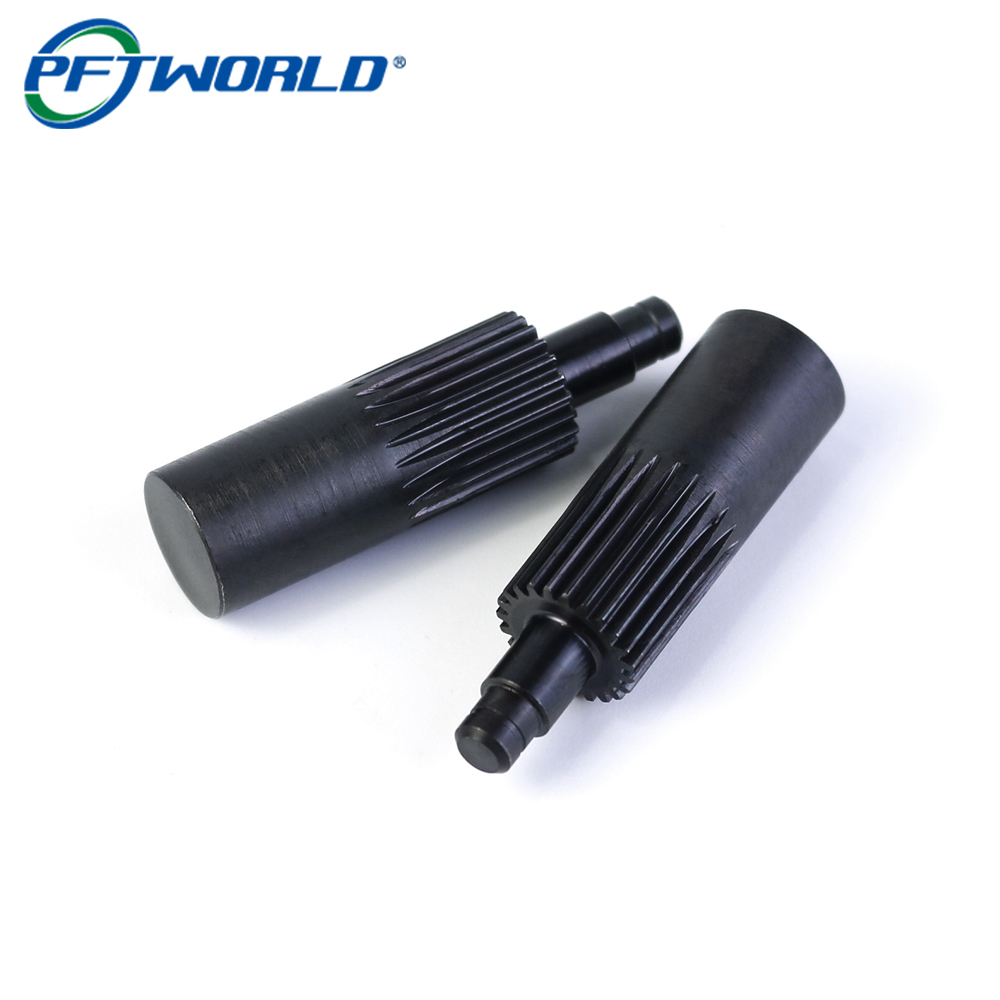
Firstly, this mechanical part is made of 40Cr material. This synthetic steel is widely used in the industrial field due to its excellent comprehensive mechanical properties. 40Cr has good quenching and hardening properties as well as fatigue resistance, and can maintain stable mechanical behavior under the working conditions of torque and impact loads. It is particularly suitable for medium to high-load transmission components. In line with the current rigid demand of the equipment manufacturing industry for high-strength materials, the selection of this material conforms to the pursuit of durable mechanical performance in the global market.
In terms of processing techniques, this piece has been precisely arranged and optimized. The initial turning process is used to form the basic contour dimensions and the axis reference. Subsequently, through professional gear hobbing technology, a precise gear profile is formed. This process requires extremely high standards for tool quality, machine rigidity, and control of processing parameters. Then, heat treatment is carried out to enhance the hardness and wear resistance of the material, achieving the desired austenitization and quenching effect in the internal structure, which directly affects the lifespan performance of the component. After heat treatment, a second turning process is carried out to ensure that all key dimensions can reach a high precision tolerance standard of ±0.01 millimeters in the hardened state. Finally, blackening surface treatment is adopted to improve the oxidation resistance while maintaining a low-reflective industrial appearance.
In the current international situation, Europe and the United States are continuously deepening their strategies of promoting domestic equipment substitution and supply chain diversification. The quality control, process stability, and supply flexibility of precision mechanical components have become important considerations for buyers when making purchasing decisions. This product is suitable for both small-batch trial production and large-scale batch production. It not only meets the high precision requirements during the engineering prototype development stage, but also ensures consistency and quality stability during the mass production stage. This is particularly crucial for overseas buyers who are seeking supply chain flexibility and cost-effectiveness.
Meanwhile, with the accelerating trend of manufacturing upgrading in Southeast Asia and South America, local industrial enterprises have begun to focus on partners that can provide customized and high-standard processing capabilities. The production process of this mechanical part covers the entire process of machining from conventional turning to complex contour hobbing and heat treatment, highlighting the competitive advantages in multi-process coordination and quality tracking.
The demand for high-value-added CNC processing services in the international market is continuously rising. Especially, small-batch orders with agile delivery capabilities are gradually becoming the mainstream procurement model. This trend aligns with the global manufacturing industry's shift from large-scale inventory to on-demand production and agile response supply strategies. High-precision synthetic steel mechanical parts are not only the basic units of the industrial manufacturing system but also a crucial link in promoting intelligent manufacturing and improving equipment reliability.
It can be foreseen that in the future, driven by the reshaping of the industrial chain structure and the optimization of the global manufacturing collaboration model, precision CNC processing products with stable process flows and high-performance materials support will have greater market opportunities.