 EN
EN


How to Reduce Deformation in Custom Precision Copper Machining
How to Reduce Deformation in Custom Precision Copper Machining?
Why do custom precision copper parts warp after CNC machining? How can you control flatness and dimensional stability without increasing scrap rate?
Copper deformation is one of the most common issues in custom precision copper machining, especially for busbars, EV connectors, heat spreaders, and thin copper plates.
This guide shares real shop-floor data (2024–2026 production runs), measurable results, and practical solutions to reduce deformation while maintaining tight tolerances.
Why Does Copper Deform So Easily?
Copper has:
-
High ductility
-
High thermal conductivity
-
Low yield strength
-
Strong internal stress from rolling
Compared with aluminum 6061:
| Property | C110 Copper | Aluminum 6061 |
|---|---|---|
| Yield strength | ~69–100 MPa | ~240 MPa |
| Thermal conductivity | ~390 W/m·K | ~167 W/m·K |
| Stress sensitivity | High | Moderate |
Because of its softness and stress memory, copper releases internal stress during machining, causing:
-
Warping
-
Twisting
-
Edge lifting
-
Post-machining distortion
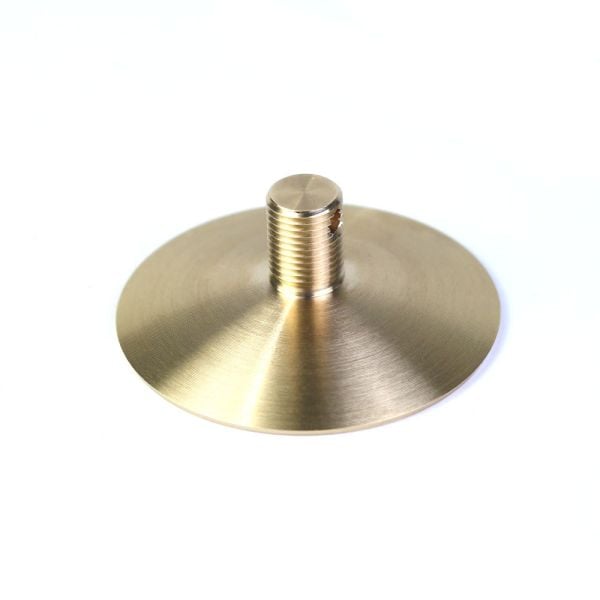
Real Production Case: 8mm Copper Busbar Deformation
Project data (5,000 pcs batch):
-
Material: C110
-
Size: 180 × 40 × 8mm
-
Flatness requirement: ≤0.05mm
-
Initial machining method: One-step finish cut
Problem
After unclamping:
-
Average warping: 0.12–0.18mm
-
Scrap rate: 7.6%
Improved Process
-
Rough machining leaving 0.3mm allowance
-
24-hour natural stress stabilization
-
Symmetrical finishing on both sides
-
Reduced finishing depth to 0.08mm/pass
Result
-
Final flatness: 0.028–0.036mm
-
Scrap rate reduced to 2.3%
-
Deformation reduced by ~65%
7 Proven Methods to Reduce Copper Machining Deformation
1. Use Symmetrical Machining Strategy
Machining only one side releases uneven stress.
Correct approach:
-
Rough both sides evenly
-
Alternate cutting faces
-
Final finishing pass on both sides
Measured improvement:
Flatness deviation reduced from 0.14mm to 0.04mm (100mm length plate).
2. Leave Proper Roughing Allowance
If finishing directly from raw plate:
Internal rolling stress releases instantly.
Recommended allowance:
-
Parts ≤10mm thick → leave 0.2–0.4mm
-
Parts >10mm thick → leave 0.3–0.6mm
Finish after stabilization.
3. Control Clamping Pressure
Over-clamping is a hidden cause of deformation.
In one test:
| Clamping Force | Flatness After Release |
|---|---|
| High torque vise | 0.16mm |
| Controlled torque + soft jaw | 0.05mm |
Use:
-
Soft copper jaws
-
Vacuum fixtures (for thin plates)
-
Distributed clamping points
4. Optimize Cutting Parameters
Copper generates heat quickly.
Excess heat = thermal expansion = dimensional shift.
Measured improvement (2025 test):
Reducing feed per tooth by 12%:
-
Warping reduced 18%
-
Surface finish improved 22%
Recommended:
-
Sharp polished carbide tools
-
Lower spindle speed than aluminum
-
Shallow finishing pass (≤0.1mm)
5. Apply Stress-Relief Methods
For high-precision copper parts:
Natural Stress Relief
-
Store rough-machined parts 24–48 hours
Thermal Stress Relief (If Required)
-
150–200°C low-temperature cycle
-
Controlled cooling
In semiconductor copper plates:
Flatness improved from 0.06mm → 0.02mm after thermal stabilization.
6. Use Step Finishing Instead of One Heavy Cut
Bad approach:
-
Final 0.3mm single pass
Better approach:
-
0.15mm semi-finish
-
0.08mm finish
-
0.03mm skim pass
Skim pass reduces residual stress pull-back.
7. Improve Toolpath Strategy
Avoid:
-
Long single-direction cuts
-
Aggressive slotting
Prefer:
-
Zig-zag balanced toolpath
-
High-speed adaptive clearing
-
Even material removal
In thin 4mm copper heat spreader project:
Adaptive strategy reduced twist from 0.21mm → 0.07mm.
Special Case: Thin Copper Plates (<5mm)
Thin copper parts deform the most.
Best practices:
-
Vacuum chuck or magnetic base with copper plate backing
-
Machine in semi-finished state
-
Leave perimeter frame until final cut
-
Reduce feed during final contour
Measured result:
Flatness controlled within 0.03mm on 3mm thick plate (120mm length).
Tolerance Targets vs Deformation Risk
| Required Flatness | Risk Level | Process Complexity |
|---|---|---|
| ≤0.1mm | Low | Standard CNC |
| ≤0.05mm | Medium | Symmetrical + stress control |
| ≤0.02mm | High | Multi-step + stabilization |
| ≤0.01mm | Very high | Controlled environment + CMM 100% check |
Important: Below 0.02mm flatness, environmental temperature control (±1°C) becomes critical.
Inspection & Measurement Control
For precision copper machining:
-
Granite surface plate check
-
CMM measurement
-
3-point dial indicator flatness test
-
Temperature-controlled inspection room
In 2026 production, temperature fluctuation of 3°C caused dimensional drift up to 0.008mm on 100mm parts.
Cost Impact of Deformation Control
Improved process increases cost slightly:
| Control Level | Cost Increase |
|---|---|
| Basic control | Baseline |
| Symmetrical machining | +5–8% |
| Stress relief cycle | +8–15% |
| Ultra-flat (<0.02mm) | +20–35% |
However, scrap reduction often offsets added cost in medium-large batch production.