Shenzhen Perfect Precision Products Co., Ltd.

All Categories
News

Home /  News & Blog /  News

Precision CNC Machined Gears: A Technical Guide

Oct.31.2026

Technical Knowledge Series

Precision CNC Machined Gears: A Technical Guide to Materials, Tolerances & Quality Control

An engineer-level breakdown of how precision gears are designed, machined, and inspected — plus answers to the questions sourcing engineers ask most.

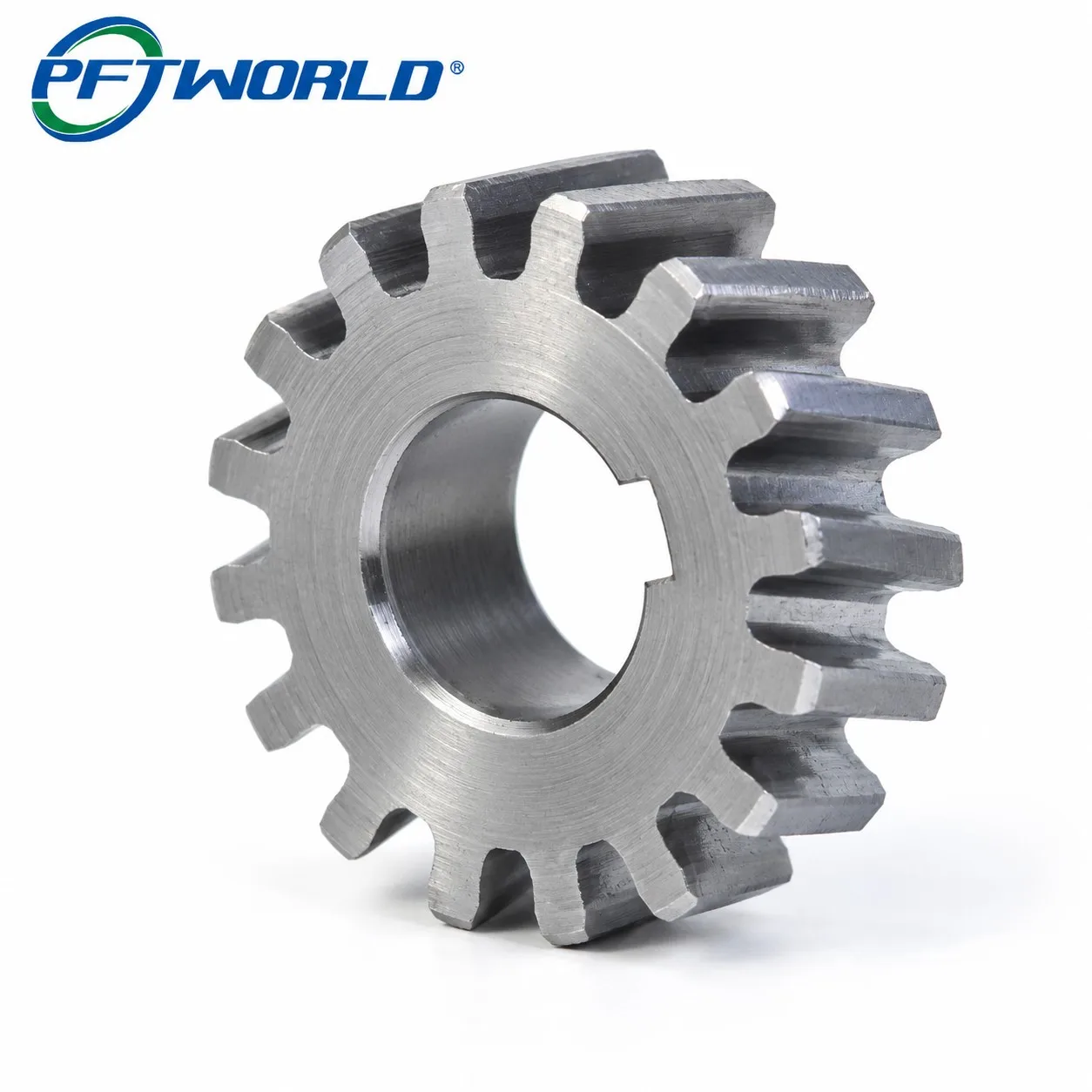
PFTWORLD precision CNC machined steel spur gear close-up

Gears are among the least forgiving components in any mechanical assembly — a few microns of error on a tooth profile can translate into noise, backlash, premature wear, or outright gear train failure. This guide walks through the four engineering decisions that determine whether a custom CNC gear performs reliably in the field: material selection, tolerance control, manufacturing process, and quality verification.

1. Material Selection for Precision Gears

Material choice is driven by load, speed, operating environment, and cost target. Alloy steels (e.g. 20CrMnTi, 40Cr) remain the default for high-load, high-cycle gear trains due to their case-hardening response. Stainless steel is specified where corrosion resistance matters — medical devices, food equipment, marine gear boxes. Brass and aluminum offer lighter weight and easier machinability for low-load or cost-sensitive assemblies, while engineering plastics like POM/Delrin are chosen for quiet, self-lubricating, low-torque applications.

Alloy Steel 20CrMnTi Stainless 303/304/316 Brass C360 Aluminum 6061/7075 POM / Delrin

2. Tolerance Control & Gear Accuracy Classes

Gear quality is specified against recognized standards — DIN 3960/3961 or AGMA 2000/2015 — rather than a generic "tight tolerance" claim. For precision industrial gears, DIN Class 5–7 (equivalent to AGMA Class 10–12) is a realistic target on CNC hobbing/shaping centers, with pitch diameter held to ±0.005–0.01mm and tooth runout under 0.01mm. Selecting the right accuracy class (rather than over-specifying) is itself a cost-control decision — pushing beyond DIN 5 usually requires grinding, which adds significant cycle time.

DIN 3 – DIN 7 AGMA Class 10–12 ±0.005mm Pitch Control Runout < 0.01mm

3. CNC Manufacturing Process Flow

A typical precision gear process starts with CNC turning-milling to establish the hub, bore, and keyway, followed by hobbing or gear shaping to cut the tooth profile. Parts requiring high hardness go through heat treatment (carburizing or induction hardening), after which distortion is corrected and final accuracy achieved via precision grinding. Every transition — especially the move from soft-machining to post-heat-treatment grinding — is a point where dimensional drift must be actively controlled, not just inspected after the fact.

CNC Turning-Milling Hobbing / Gear Shaping Heat Treatment Precision Grinding

4. Quality Inspection & Certification

Verification should match the tolerance class claimed. CMM inspection confirms bore, keyway, and overall dimensions; dedicated gear tooth profile testers (involute, lead, pitch) confirm the actual DIN/AGMA class achieved — a step many shops skip. Reputable suppliers also provide material test certificates (MTC) for traceability and operate under ISO 9001, with IATF 16949 for automotive-grade programs.

CMM Inspection Gear Profile Testing ISO 9001 IATF 16949 Material Test Certs

Frequently Asked Questions

Common technical questions from sourcing and design engineers

Q

What tolerance can CNC machining achieve for small precision gears?

With CNC hobbing/shaping plus grinding, DIN Class 5–7 (±0.005–0.01mm pitch control) is achievable for small-to-medium gears. Tighter classes are possible but increase cost and lead time — specify only what the application genuinely requires.

Q

Which material is best for a high-load industrial gear?

Case-hardened alloy steel (e.g. 20CrMnTi) is the standard choice for high-load, high-cycle gear trains because it combines a wear-resistant surface with a tough, shock-absorbing core.

Q

Do you provide prototype or sample gears before mass production?

Yes — a sample or small pilot batch is standard practice before committing to tooling and mass production, allowing dimensional and functional validation first.

Q

What is the typical lead time for a custom CNC gear order?

Lead time depends on material, heat treatment, and accuracy class, but typically ranges from design confirmation and sample delivery to mass production scheduling once specifications are finalized.

Q

Can gears be machined to match DIN or AGMA standards?

Yes. Gears can be specified and inspected against DIN 3960/3961 or AGMA 2000/2015 classes, with test reports provided for traceability on request.

Q

Do you offer surface treatment and heat treatment options?

Yes — options typically include carburizing, induction hardening, black oxide, zinc plating, and other surface finishes depending on the operating environment and corrosion requirements.

Need a Custom Precision Gear Machined to Spec?

Share your drawing, material, and tolerance requirements — PFTWORLD engineers will review DFM and provide a tiered quote (sample / pilot / mass production).

Request a Technical Quote
PFTWORLD · Precision CNC Machining & Custom Gear Manufacturing
© PFTWORLD — Technical Knowledge Series. Content for engineering reference purposes.

Get a Free Quote

Our representative will contact you soon.
Email
Name
Company Name
Message
0/1000