 EN


Internal Spline Ring Flanges: A Technical Guide to Design, Manufacturing & Tolerances
Internal Spline Ring Flanges: A Technical Guide to Design, Manufacturing & Tolerances
Engineering insights on tooth geometry, broaching vs. wire EDM, surface treatment, and DFM best practices for precision CNC-machined flange components.
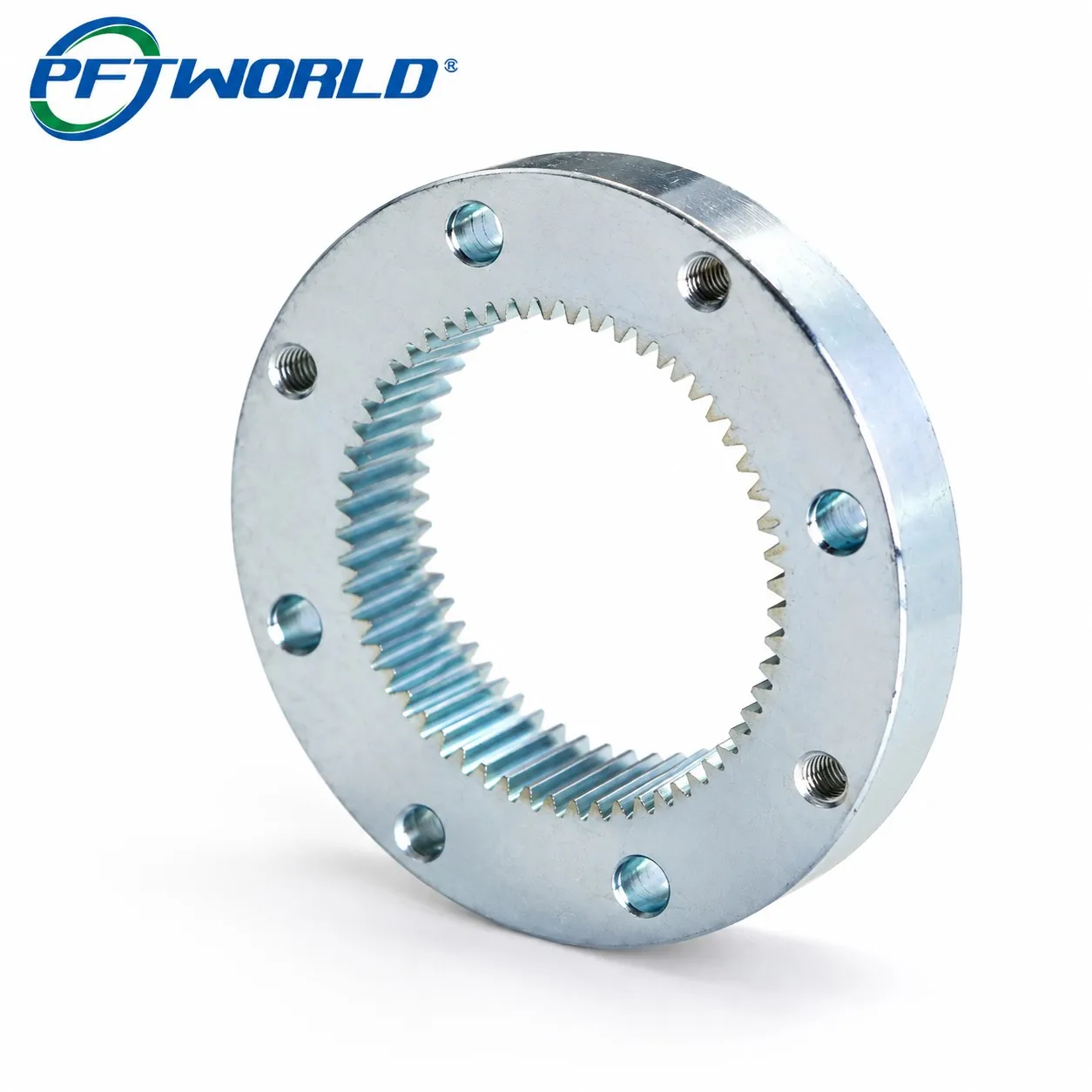
What Is an Internal Spline Ring Flange?
An internal spline ring flange — like the zinc-plated steel part shown above — is a precision-machined component that combines a flat, boltable mounting flange with an internally splined (or internally toothed) bore. The internal teeth engage a matching splined shaft or gear to transmit torque, while the surrounding flange face provides a rigid, repeatable interface for bolted assembly. This hybrid geometry makes the part a common building block in gearboxes, drivetrains, clutch assemblies, and rotary actuators, where torque transfer and secure mounting must occur within a single compact footprint.
How It's Manufactured
Producing an internal spline ring flange typically combines two machining disciplines. CNC turning first establishes the outer diameter, flange thickness, and bolt-hole pattern, holding tight concentricity between the flange face and the bore axis. The internal spline teeth are then generated by broaching, shaping, or wire EDM, depending on tooth count, module, and batch volume.
Broaching offers the best balance of tooth-profile accuracy and cycle time for small-to-medium production runs. Wire EDM is preferred for hardened materials or non-standard tooth forms that broach tooling cannot reach, though it adds per-piece processing time.
Materials & Surface Treatment
Material and coating selection directly affect torque capacity, wear life, and corrosion resistance. Typical specifications for this part family include:
Design for Manufacturability (DFM) Considerations
When specifying an internal spline ring flange, four variables most strongly influence manufacturability and cost: tooth module and pressure angle, bore depth-to-diameter ratio, bolt-circle tolerance, and plating thickness. A deep, narrow bore limits broach rigidity and may require a stepped or guided cutting sequence. It's also essential to confirm whether the mating shaft spline follows DIN 5480, ANSI B92.1, ISO 4156, or a custom profile — tooling selection, and therefore lead time, depends entirely on that standard.
Typical Applications
Frequently Asked Questions
Common engineering questions about internal spline ring flange design and sourcing.
What is the typical tolerance for internal spline teeth?
Most industrial applications specify an IT7–IT8 tooth tolerance class, with bore-to-flange concentricity held within 0.02–0.05 mm depending on load and rotational speed requirements.
Why is zinc plating used instead of other coatings?
Zinc electroplating provides reliable corrosion resistance at low cost with minimal added thickness — important because plating buildup can affect spline fit. For harsher environments, black oxide, nickel, or Dacromet coatings are common alternatives.
Can internal spline flanges be made from materials other than steel?
Yes. Carbon and alloy steels are most common for torque-transmitting applications, stainless steel suits corrosion-prone environments, and aluminum alloys are selected when weight reduction outweighs load requirements.
What's the difference between broaching and wire EDM for spline cutting?
Broaching is faster and more cost-effective for medium-to-high volumes with standard tooth geometry. Wire EDM is slower but tool-less, making it ideal for hardened materials, prototypes, or non-standard spline profiles.
How do I choose the right spline standard for my project?
Match the internal spline to your mating shaft's existing standard — commonly DIN 5480, ANSI B92.1, or ISO 4156 — to avoid custom tooling costs. If no standard applies, provide a fully dimensioned tooth profile drawing early so your supplier can quote tooling lead time accurately.
Need a Custom Internal Spline Ring Flange?
Get a free DFM review and CNC machining quote from the PFTWORLD engineering team.
Request a Quote