 EN
EN


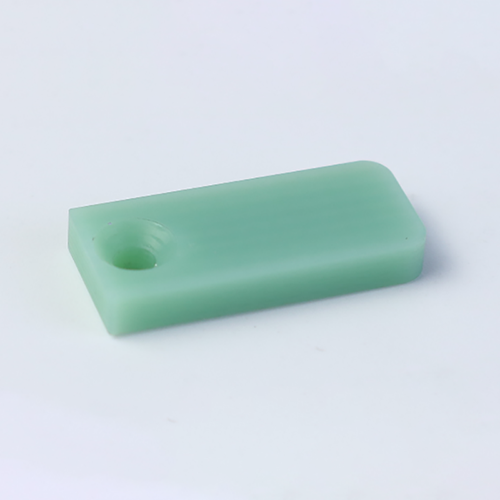
Precision CNC Milling of FR4 Parts for Electronics
Against the backdrop of the accelerated restructuring of the global electronics industry chain and the surging demand for high-performance insulating materials, an innovative precision CNC milling process for green FR4 epoxy resin boards is drawing industry attention. With the official implementation of the EU's Critical Raw Materials Act and the strengthening of the construction of independent supply chains for electronic basic components by major economies around the world, the processing accuracy and reliability of this key material, which is widely used in high-frequency circuit boards, power insulation systems and high-end testing equipment, are becoming a new yardstick for measuring the resilience of the manufacturing industry.
The traditional FR4 sheet processing has long been confronted with common problems such as easy chipping of the glass fiber layer, thermal stress deformation, and insufficient dimensional stability. Recently, leading manufacturers in the industry have achieved stable mass production capabilities with a precision of 0.05mm by integrating three core technologies: multi-axis linkage control, intelligent tool compensation, and digital modeling of process parameters. What is more notable is that by establishing a prediction model of "material properties - processing parameters - performance output", the manufacturer has for the first time increased the dielectric strength retention rate of FR4 parts to 98.5% and improved the control accuracy of heat distortion temperature by 40%.
Process Reengineering: Establishing a New Standard for the Seven-dimensional Quality Control System
In response to the increasingly strict requirements for FR4 structural components in high-end electronic devices, an innovative process has been established to build a seven-stage quality control chain throughout the entire process:
Digital archiving of materials: 12 parameters such as the glass fiber weaving density and resin curing degree of each batch of FR4 base materials are entered into the process database
Adaptive programming system: Automatically optimizes milling paths and cooling strategies based on the characteristics of material batches
Micro-environment control processing: Constant temperature and humidity control in the processing chamber, with temperature fluctuation ≤±0.5℃
Online stress monitoring: Optical fiber sensors monitor the microscopic stress changes in the processing area in real time
Stepped accuracy correction: Automatically perform reference surface accuracy compensation after 30% of the processing volume is completed
Non-contact detection: Laser scanners achieve sub-micron surface defect identification
Electrical performance verification: Each batch of samples is sampled for six electrical performance tests including high-voltage breakdown and insulation resistance
Data shows that this system has raised the product yield rate from the industry average of 76% to 94.3%, and reduced the standard deviation of batch consistency to one fifth of that of traditional processes.
Industrial value: Three-dimensional Supply Chain empowerment
In the current regional reorganization process of the global electronics industry chain, this technological innovation is generating strategic value far beyond the technical level:
Technological autonomy breakthrough: Through a completely independently developed tool wear prediction algorithm, the service life of CBN-specific tools has been increased by 2.3 times, reducing the reliance on imported consumables. The processing technology knowledge base has accumulated over 1,200 parameter combination schemes, forming a technical barrier.
Supply chain response upgrade: Digital process packages have reduced product switching time by 68% and support "hourly" parameter adjustment in response to customer design changes. A verification by a certain medical device customer shows that it only takes 72 hours from the confirmation of the drawings to the delivery of the first batch of samples.
Green manufacturing transformation: The innovative coolant circulation system achieves zero waste liquid discharge, and the processing dust collection efficiency reaches 99.97%. Compared with traditional processing methods, it reduces the generation of hazardous waste by 420 kilograms per 10,000 products, perfectly meeting the requirements of the EU's "Eco-Design Regulation for Sustainable Products".
Future Outlook: From precision Processing to ecological construction
With the explosive demand for high-performance insulating components in emerging fields such as 6G communication, high-voltage platforms for new energy vehicles, and space electronic equipment, green FR4 precision processing technology is evolving into an interdisciplinary systems engineering. Industry observers point out that the successful practice of this process reveals a new trend: the competitive focus of high-end manufacturing is shifting from single processing capabilities to the ecological construction capabilities of "materials science - process technology - testing standards" in a trinity.
It is worth noting that this innovative process has given birth to a modular service model: customers can choose different cooperation levels from standard processing to "performance-guaranteed manufacturing" based on their needs. The latter offers value-added services including a five-year warranty period, full batch data traceability, and application environment simulation testing. This flexible manufacturing service is precisely the most effective buffer design to deal with the uncertainty of the supply chain.
Today, in the context of profound adjustments in the global landscape, building a "small ecosystem, strong resilience" manufacturing system by delving deeply into niche fields is becoming a strategic choice for precision manufacturing enterprises to weather the cycles. The breakthrough in the precision processing of green FR4 parts not only demonstrates the technological depth of high-end manufacturing but also points out a new path for the value reconstruction of the industrial chain - only by upgrading the manufacturing of each part to a complete technical system that is controllable, predictable and optimizable can the foundation of industrial development be consolidated in the changing situation.